
I've made five trips to Bandon Dunes: two in summer and three in late fall and winter. I've played it in short sleeves on perfect summer days, and I've lost rounds to December storms. The weather shapes a Bandon trip more than almost any other variable, so below is what each season actually plays like: the climate numbers for every month, plus what I found on the ground in the months I've been there.
The short answer: Summer (June through September) is the most reliable window, with highs in the mid to upper 60s and very little rain. Winter (November through March) is a gamble: plan on losing a round or two to weather, and you'll also find more availability. The shoulder months (April, May and October) sit between the two. I haven't played Bandon in the shoulder months, but they're what I'd suggest to a friend who wants value: the weather is still a bit of a roulette wheel, but the odds are more in your favor.
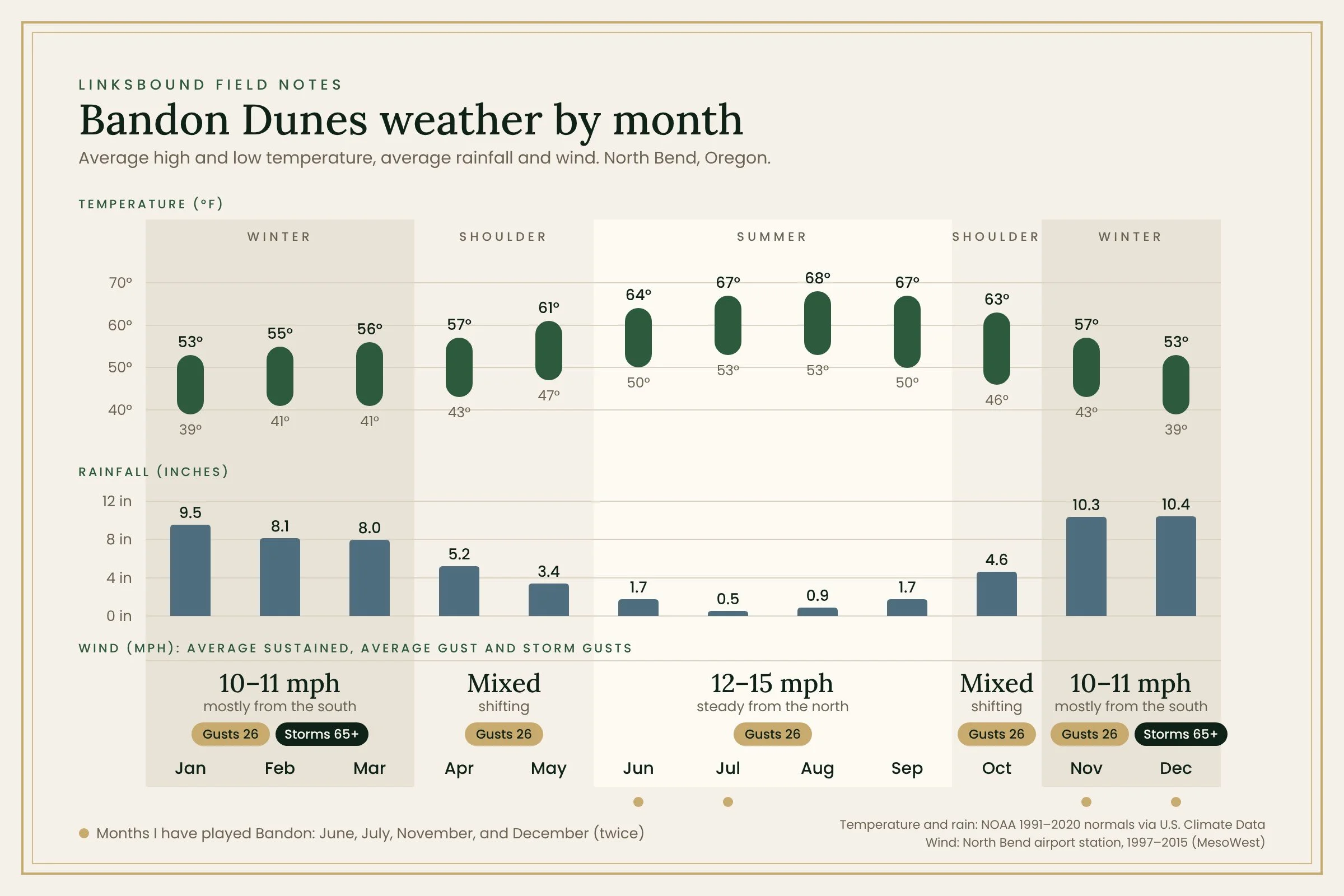
Bandon Dunes weather by month chart showing average high and low temperatures, average rainfall and average wind speed for each month, North Bend, Oregon
Bandon Dunes weather by month at a glance
The chart above uses NOAA's 1991 to 2020 climate normals for North Bend, Oregon, the nearest long-running weather station and the airport most Bandon golfers fly into. Wind speeds come from the North Bend airport station's records (1997 to 2015). A few things stand out:
The temperature barely moves. Average highs run from 53°F in December and January to 68°F in August. That's a 15-degree swing across the whole year. Bandon is never hot, and it's rarely truly cold.
Rain is the real variable. July averages about half an inch of rain for the month. November and December each average more than 10 inches. That's the difference between a trip you plan around golf and a trip you plan around the weather.
It's windy year-round, and the wind changes direction with the seasons. Sustained wind averages about 12 mph across the year, and gusts average about 26 mph. Summer is the windiest stretch on average, at roughly 12 to 15 mph. Winter averages a bit less, about 10 to 11 mph, but brings the biggest gusts of the year with its storms. Direction changes too: from May through October the prevailing wind blows from the north, and from November through April it comes from the south-southeast, the direction winter storms arrive from. A hole you remember as downwind in July can play straight into it in December.
September is the sleeper month. It has summer temperatures (67°F average high) and only 1.7 inches of rain, about the same as June.
Summer at Bandon Dunes (June through September)
This is Bandon at its most dependable, and the resort's peak season for a reason.
What I found: I went in summer 2008 (July, as best I remember) and again in June 2024. Both trips were close to perfect. No rain on either trip, and I played a couple of rounds in short sleeves, which at Bandon is a real treat.
What to expect:
Average highs of 64°F to 68°F and lows around 50°F to 53°F. Mornings start cool, so you'll still want a layer for the first few holes.
Very little rain. July and August average under an inch for the month.
Long days. Summer daylight makes 36 holes in a day realistic, and Bandon's replay rates make the second round more affordable.
Wind from the north. Summer is the windiest season on average, with sustained winds of roughly 12 to 15 mph, and the north wind tends to build through the afternoon. Morning rounds usually play calmer.
The tradeoff: Summer is the hardest time to get in and the most expensive time to be there. If you're bringing a group in summer, room availability is the constraint, not the weather. My guide to booking Bandon Dunes covers how the group lottery works for peak dates.
Shoulder seasons (April, May and October)
I haven't played Bandon in these months, so this section is based on the climate data, not my own rounds.
May looks like the best of the spring months: a 61°F average high and 3.4 inches of rain, about a third of what falls in winter.
April is cooler (57°F) and wetter (5.2 inches). Closer to winter than summer.
October is the mirror image of May: a 63°F average high and 4.6 inches of rain, with the wet season usually arriving late in the month.
If you want to avoid both summer pricing and real winter weather, May and early October are where I'd look. Weather here can still be a bit of roulette, but the odds are more in your favor than in December.
Winter at Bandon Dunes (November through March)
This is the season I know best. I've been three times: December 2022, December 2024 and November 2025. Here's how each trip played:
[IMAGE: bandon-winter-trips.jpg] Alt text: Three winter trips to Bandon Dunes, December 2022, December 2024 and November 2025, and how each played
What to expect:
Average highs of 53°F to 57°F and lows around 39°F to 43°F.
Rain. November, December and January each average 9.5 to 10.4 inches. That doesn't mean it rains all day every day. It means you should expect some of it on most trips, and a washout day or two on some.
Wind from the south. Winter winds come mainly from the south and average about 10 to 11 mph, but the strongest gusts of the year arrive with winter storms. On a calm, dry winter day, though, Bandon can be as good as it gets.
Shorter days. With sunset before 5 p.m. in December, 36 holes is a stretch. Plan for one round a day plus the Punchbowl or a short course.
Why go in winter at all? Availability. Demand drops after the summer season, which makes it much easier to find rooms and tee times, especially on short notice. I've gone in November and December because the Thanksgiving and Christmas weeks are when I'm off anyway, and I've never had trouble finding a room. For a full breakdown of a November trip, including the course order, caddies and what it cost, see my Bandon Dunes golf trip from November 2025.
My five winter rules for Bandon
Add a day. If you want four rounds, book five days. Expect to lose a round or two to weather, and you'll come home happy instead of short.
Watch the forecast, then shuffle. Move your must-play course to the best-looking day. It's easier to rearrange a winter itinerary because tee sheets are lighter.
Pack for options, not just for rain. Start with a fully waterproof rain suit, waterproof shoes and a warm hat. Bandon is walking-only, so you'll be out in it for four-plus hours. Bring two kinds of gloves: rain gloves for the wet days and winter gloves for the cold ones. FootJoy makes great options for both that really do work: RainGrip for rain and WinterSof for cold. Beyond the rain gear, I bring two weights of long underwear: a heavier, heat-trapping set for the cold days and a lighter set for the milder ones. Winter conditions change a lot from one day to the next, and having both lets me dress for the day I actually get.
Change your socks between 18s. If you're playing 36, put on a fresh, dry pair at the turn. I can't fully explain why, but it makes a real difference in how the second round feels.
Embrace the conditions. Bandon was built to play firm and fast in the wind. A blustery, dry December day is closer to true links golf than a calm July afternoon.
For more on how seasonality affects pricing and availability across destinations, see when golf trips peak.
A pro tip: go as a single
If you're flexible on who you travel with, going to Bandon as a single golfer is a huge unlock, in any season. Singles have a much easier time finding rooms, because one cancellation is enough to open a spot. Winter makes it easier still, since demand is lower. On two of my trips I had to switch rooms mid-stay to make my dates work, which was no trouble at all.
Groups are a different story, especially in summer. If you're planning for four, eight or more, start with how to book Bandon Dunes, and see how to get to Bandon Dunes for flight and drive options.
Frequently asked questions
What is the best month to play Bandon Dunes? For weather alone, July through September. They're the warmest and driest months, with average highs of 67°F to 68°F and under two inches of rain. September is often overlooked and offers summer conditions as demand starts to ease.
Is Bandon Dunes open in winter? Yes. Bandon Dunes is open year-round. Winter brings more rain and wind, but also more availability, and many days are very playable.
How much does it rain at Bandon Dunes in December? December is the wettest month, averaging about 10.4 inches in nearby North Bend. Expect rain on part of most winter trips, and plan an extra day in case you lose a round.
What is Bandon Dunes weather like in November? Average highs are around 57°F and lows around 43°F, with about 10 inches of rain for the month. My November 2025 trip was chilly with on-and-off wind, but I played every round.
What is Bandon Dunes weather like in January? January is one of the coolest months, with an average high of 53°F, a low of 39°F and about 9.5 inches of rain. Plan for the same approach as December: an extra day and full rain gear.
Is it always windy at Bandon Dunes? Most days have real wind. Sustained wind averages about 12 mph across the year, with gusts averaging about 26 mph. In summer, a steady north wind tends to build through the afternoon. In winter, the wind comes mainly from the south and is gustiest during storms. Calm days happen in every season.
What should I pack for Bandon Dunes? Layers in every season. In summer, a windproof layer and a light rain jacket. From October through April, a fully waterproof rain suit, waterproof shoes, a warm hat, both rain gloves and winter gloves (I use FootJoy RainGrip and WinterSof), and two weights of long underwear (one heavier, one lighter) so you can match the day's conditions. Bring extra socks so you can change into a dry pair between rounds.
Plan your Bandon trip
Choosing the right month is the first decision, and it affects everything after it: which courses you play when, how many days you book and how you handle the group lottery. If you'd like help planning a Bandon trip around the season that fits your group, book a consultation. The $200 consultation fee is credited toward your planning fee.