
Peak Season Is a Place, Not a Date
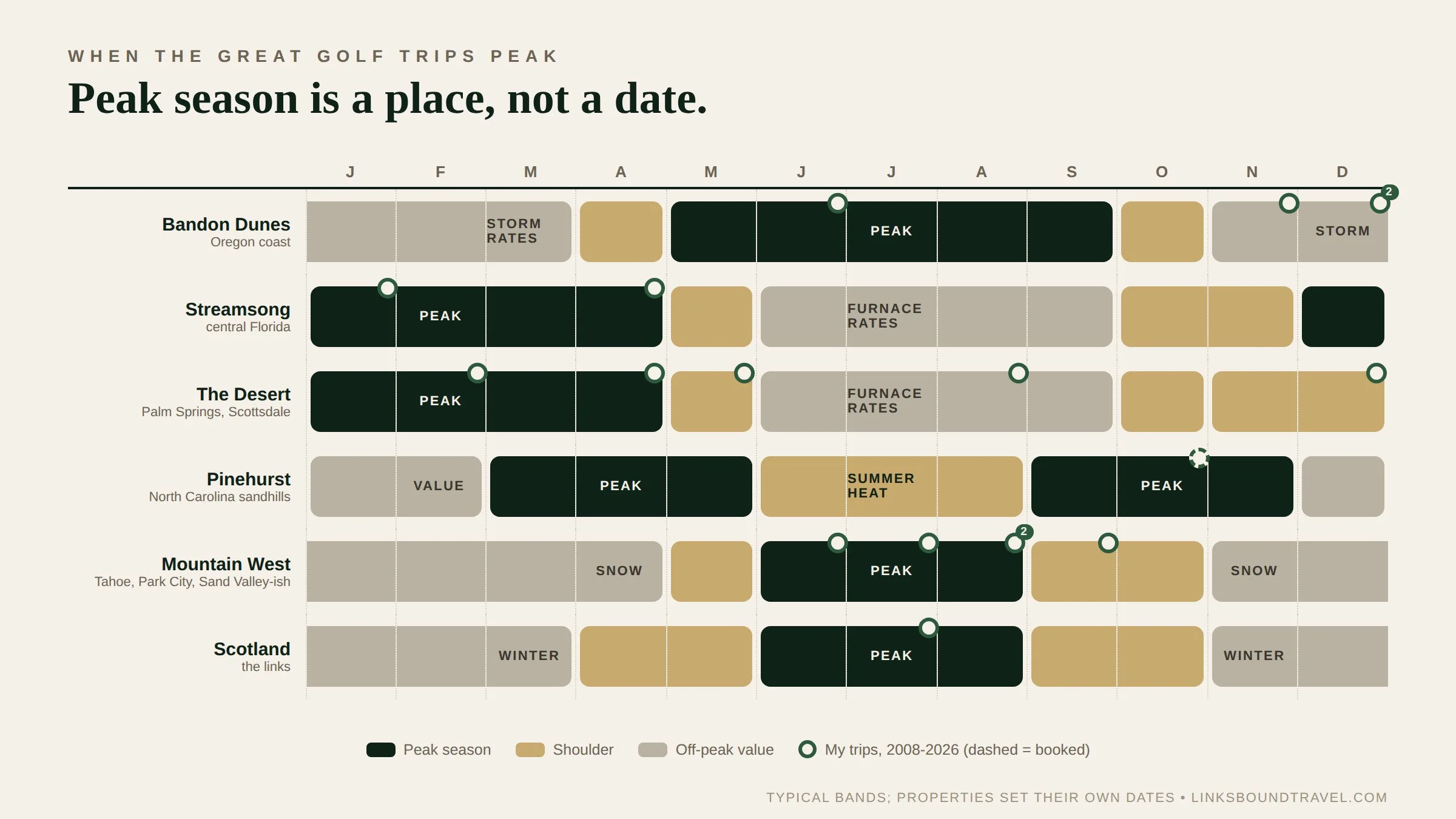
Ask when peak golf season is and most people say summer, because most people's home course peaks in summer. But the great destination trips don't share a calendar; they trade places all year. Bandon Dunes peaks in July. Streamsong peaks in January. Palm Springs empties in August while Tahoe fills, and the whole system runs on inversions that most groups never think about until a quote surprises them.
The chart above is that system in one glance, and the dots are my last eighteen years of trips scattered across it. A few of those dots sit deliberately in the gray zones, which is half of what this post is about.
Bandon Dunes: summer peak, winter honesty
Bandon's peak runs May through September, when the Oregon coast behaves and the resort charges accordingly, and it's worth every dollar. But look at the dots: two of my five Bandon trips were December trips, on purpose. Winter at Bandon means storm rates, wide-open tee sheets, and weather roulette played with real stakes: it could be great, it could be miserable, and you don't get to pick. My trick after two December trips: book an extra day or two, set your expectations that you'll be weathered out one or two days of the trip, and then anything better than that is a pleasant surprise. The resort's peak-season priority drawing (closes in December for the following peak) and its winter pricing are two ends of the same lesson: Bandon rewards people who read its calendar instead of assuming it.
Streamsong: the inverted resort
Florida runs backwards, and Streamsong is its purest golf expression: peak season is roughly December through April, when the weather is the product, and summer is the furnace-rate window, when the golf is cheap and the heat is a legitimate opponent. Both of my Streamsong trips (January 2015, back when the resort was just Red and Blue, and April 2026, ranking all three) were peak-window trips, and the tee-sheet math there has a wrinkle worth knowing: rooms and tee times are linked, so peak-season access is really a lodging question. That gets more interesting on September 19, when Bone Valley opens preview play ahead of schedule and adds a fifth course's worth of demand to the same winter sheet.
The desert: peak in January, empty in August
I live in Palm Springs, so this one comes with resident receipts: the desert's peak is January through April, when the weather is flawless and the snowbirds have the tee sheets, and the furnace window is June through September, when rates crater because afternoons are genuinely dangerous. One of my five La Quinta trips was an August trip, and the resident's honest verdict is: I wouldn't recommend it. It's brutally hot, and if you do it anyway, electrolytes and very early tee times are your friends. The desert's value play is real, but it's a dawn-patrol discipline, not a bargain vacation.
Pinehurst: the two-peak calendar
The sandhills run a double season: spring (March through May) and fall (September through November) are the peaks, summer is a heat-discounted shoulder, and winter is the quiet value window. My own Pinehurst trip lands October 7, squarely in the fall peak, booked eleven weeks out, which got us the last room on the property and taught the lead-time lesson the hard way. Two-peak destinations are the friendliest to groups with fixed windows, because two peaks means two chances.
The mountains: a season, not a calendar
Tahoe, Park City, and the Wisconsin sand belt don't have an off-peak; they have an off. Snow closes the calendar from roughly November through April, the season runs May to October, and the peak is the July-August heart of it. All five of my mountain trips sit in that band because there's nowhere else for them to sit. The planning consequence: mountain destinations compress a year of demand into five months, so their lead times run longer than their remoteness suggests.
Scotland: the one that gets its own post
Scotland's bands (high June through August, shoulder value in April-May and September-October, winter rates and the strangest Old Course bargain in golf from November through March) are mapped month by month in the Scotland season guide. It sits on the chart for the reason the chart exists: put it next to the American destinations and the trading pattern jumps out.
How to actually use this
Two kinds of groups read this chart two different ways. If your dates are flexible, the chart is a value map: the gray and gold windows, Bandon's storm season, Streamsong's furnace summer, the desert's shoulder months, are where the same courses cost a fraction of their peak numbers, for groups honest about the weather trade. If your dates are fixed, the chart is a destination picker: somewhere is always in season, and the job is matching your window to the place that peaks inside it. February group? Streamsong and the desert are at their best. July? Bandon and Scotland. October? Pinehurst's second peak is waiting.
Every window on the chart, the drawings, the applications, the booking openings that gate these trips, lives with dates on the free Planning Calendar, updated as the calendars move. And matching your group's window to the right destination at the right price is half of what the consultation does in ninety minutes: $200, credited in full toward your planning fee, and the trip comes out planned for the season it's actually in.