
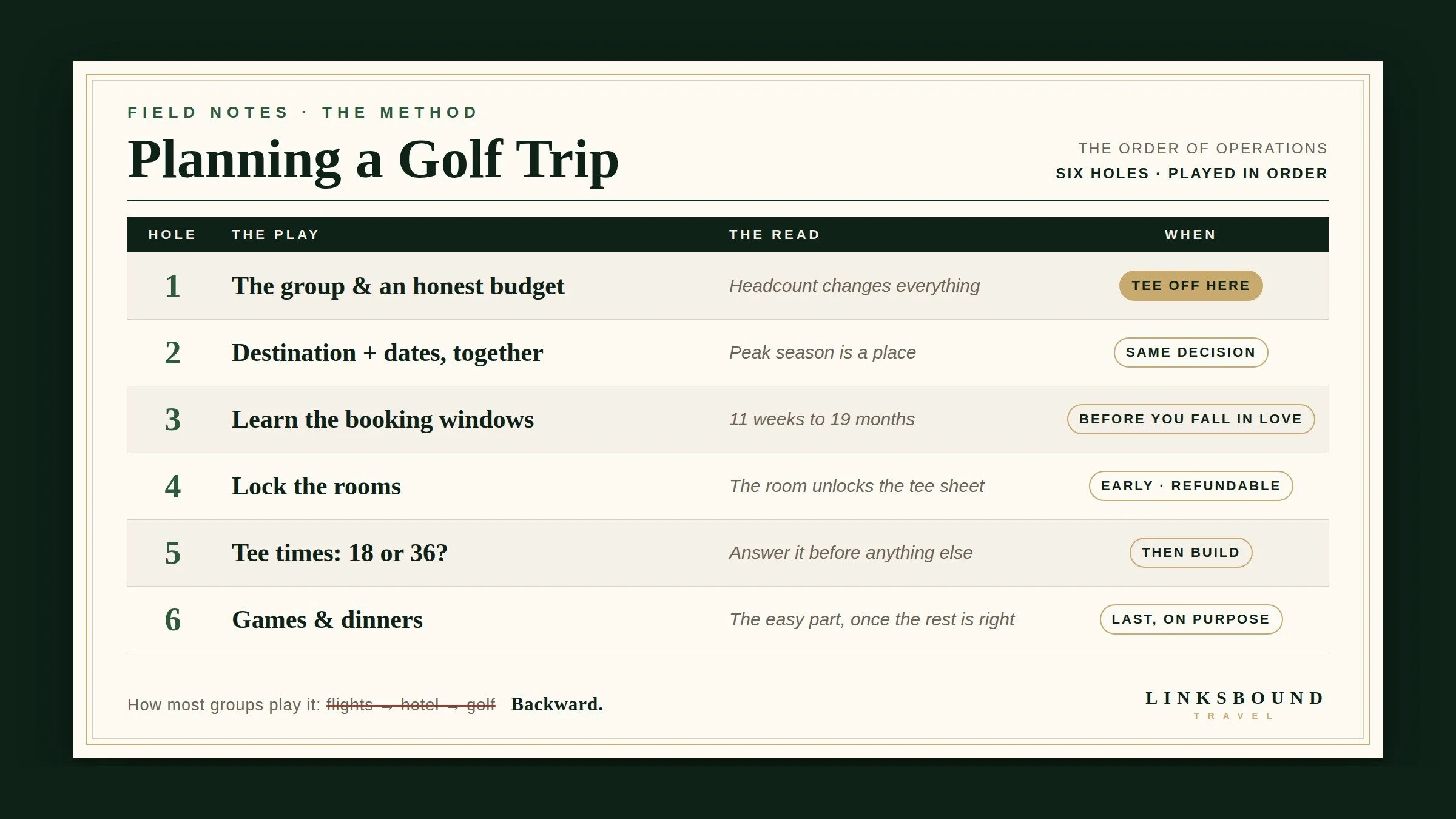
Most people plan a golf trip the way they plan a vacation: flights first, hotel second, golf whenever. That order works fine for a beach week. For a golf trip it's exactly backward, because the scarcest thing on a golf trip isn't a plane seat or a room. It's access to the golf.
I've been taking these trips most of my life, and tracking them for the past two decades: 26 trips across 10 destinations, every verdict written down. The single biggest difference between the trips that worked and the ones that almost didn't was never the destination. It was the order of operations. Here's the sequence I use, whether I'm planning for myself or for a client.
Step 1: Start with the group and an honest budget
Before any destination talk, settle two things: who's actually coming, and what each golfer is truly willing to spend.
Headcount changes everything downstream. A foursome can book almost anything online. Eight golfers wanting their own rooms is a different sport entirely: most hotel booking engines cap you at three rooms per reservation, while formal group contracts often don't start until ten. A party of seven or eight lives in the gap between those two systems, which is solvable, but only by phone, and only if you know to ask. I learned this the useful way, piecing together seven refundable rooms for a client group this winter.
The budget conversation has to be per golfer and honest. "Whatever it takes" always has a number hiding behind it. A recent group of mine set $2,500 to $3,000 per golfer for lodging and golf and ranked course quality first, and that one sentence made every later decision easy: when the budget got tight, we knew the money went to the golf.
While you're at it, rank your priorities out loud: courses, lodging, food, nightlife. You can't maximize all four. Knowing which one bends is the plan.
Step 2: Pick the destination and the dates together
Destination and dates are one decision, not two, because peak season is a place, not a date. The same week in January is the best golf of the year in the California desert and a washout at Bandon. August is prime in Scotland and brutal in Palm Springs. I wrote a whole piece on this inversion, when golf trips peak, but the short version is: decide what kind of golf you want, then let the calendar tell you where it lives that month.
This is also the moment for the honest weather conversation. Shoulder seasons are cheaper for a reason. Sometimes that reason is fine (I've been handed an empty course by a forecast that scared everyone else off), and sometimes it costs you a round. Price the risk on purpose instead of discovering it on arrival.
Step 3: Learn the booking windows before you fall in love
Here's the step almost everybody skips, and the one that quietly kills more great trips than weather or budget combined: every serious golf destination has its own booking clock, and they are wildly different.
Real numbers from my own ledger:
Pinehurst: I booked my October trip in late July, about 11 weeks out, and got the last available room on the entire property and the only tee times left that could fit my plan. Eleven weeks felt early. It was nearly too late. The full trip report is here.
Sand Valley: reservations for 2027 opened in February 2026. I booked a September 2027 trip roughly 19 months out, and shaped the dates around capturing a tee time at the Lido, because even at 19 months the window was already tightening.
Bandon Dunes: peak lodging is released in windows, and the most coveted slots run through drawings. The last cycle drew more than 51,000 entries.
Kohler: you don't simply book a round at Whistling Straits; access to the Straits course runs through resort packages, so the package is the booking.
Four destinations, four completely different clocks, and none of them care when you started dreaming about the trip. This is why I keep a running planning calendar of the windows, drawings, and openings across the destinations I track. Check the clock for your destination before you set your heart on a date.
Step 4: Lock the rooms early, at refundable rates
One of the oldest rules in destination golf: the room unlocks the tee sheet. At many of the great resorts, lodging guests can book tee times weeks or months before the public window opens. Book your bed first and the golf gets easier; do it the other way around and you can hold tee times at a resort you can't sleep at.
And here's the part that makes early feel safe: refundable rates make commitment nearly free. The seven rooms I booked for that client group cost nothing until the trip and cancel without charge until days before arrival. Booking early at a refundable rate isn't a gamble. It's a free option on the trip you want. The gamble is waiting, because availability and choice are two different deadlines: book when rooms are merely available and you often end up in the hotel that was left, not the one you wanted.
Step 5: Now the tee times, and the first question is 18 or 36
With dates set and rooms held, build the golf schedule. But before any talk of courses or start times, the group has to answer one question honestly: are these 18-hole days or 36-hole days? Everything on the tee sheet follows from the answer.
If you're playing 36 a day, daylight is the budget. The schedule writes itself from one condition: first tee time of the morning, lunch eaten on the cart. Daylight doesn't negotiate, so every afternoon round needs a realistic finish-before-dark check, especially in spring and fall. And pace yourself deliberately: walk the marquee round with a caddie, then take a cart for the second 18. Your Saturday self will thank your Friday self.
If you're playing 18 a day, you're buying the best hours of the day instead of the most of them. Skip dawn patrol. In the shoulder and winter seasons the earliest slots carry real frost-delay risk; in the desert in January, by 10 AM the air is warm, the delay roulette is behind you, and you still finish with the whole afternoon for the pool and the bets.
Two rules that hold either way:
Arrival day gets no golf, or light golf at most. If the resort has a great short course, that's exactly what it's for: the Cradle at Pinehurst or the Preserve at Bandon shakes off the travel without burning anyone's legs. Otherwise, settle in, find the bar, let the time change work itself out. The trip is better for it.
Order the rounds like a story: a warm-up, a step up, and the finale. Save the course everyone came for until the group has found its swings, and never make the hardest round the one you play off the red-eye.
Step 6: The fun layer, last on purpose
Competition and evenings come last, not because they don't matter but because they're the easy part once the skeleton is right.
For the golf itself, settle the game before anyone packs: the format argument is a great group-chat fight and a terrible first-tee fight. I built a free tool for exactly this, and a guide to the games worth putting money on.
For dinners, my current method with client groups: book one standing table each night, and on the golf days give the group two options with different moods, decided that afternoon. Nobody knows on Tuesday what they'll want after Saturday's round. Plan for both versions of the group.
What happens when the order goes wrong
Every cautionary tale I've collected is a sequence error. The group that picked dates first and learned the lodge sold out months ago. The planner who booked flights before checking that the course everyone wanted runs on a package they didn't buy. The eight-man trip that discovered the three-room booking cap two weeks out. None of these are knowledge problems; the information was always available. They're order problems.
So that's the method: group and budget, destination and dates together, the booking clock, rooms early and refundable, then tee times, then the fun. If you're planning a golf trip to Scotland specifically, I've written a deeper version of this for that trip, where the access rules deserve their own article.
Every trip in my ledger taught me something that made the next one better. If you'd rather borrow the ledger than build your own, that's what the consultation is for: $200, one conversation about your group, your budget, and your windows, credited in full toward your planning fee if we build the trip together. Book a consultation here.